
The Fairness Systems That Sit Behind Every Online Slot
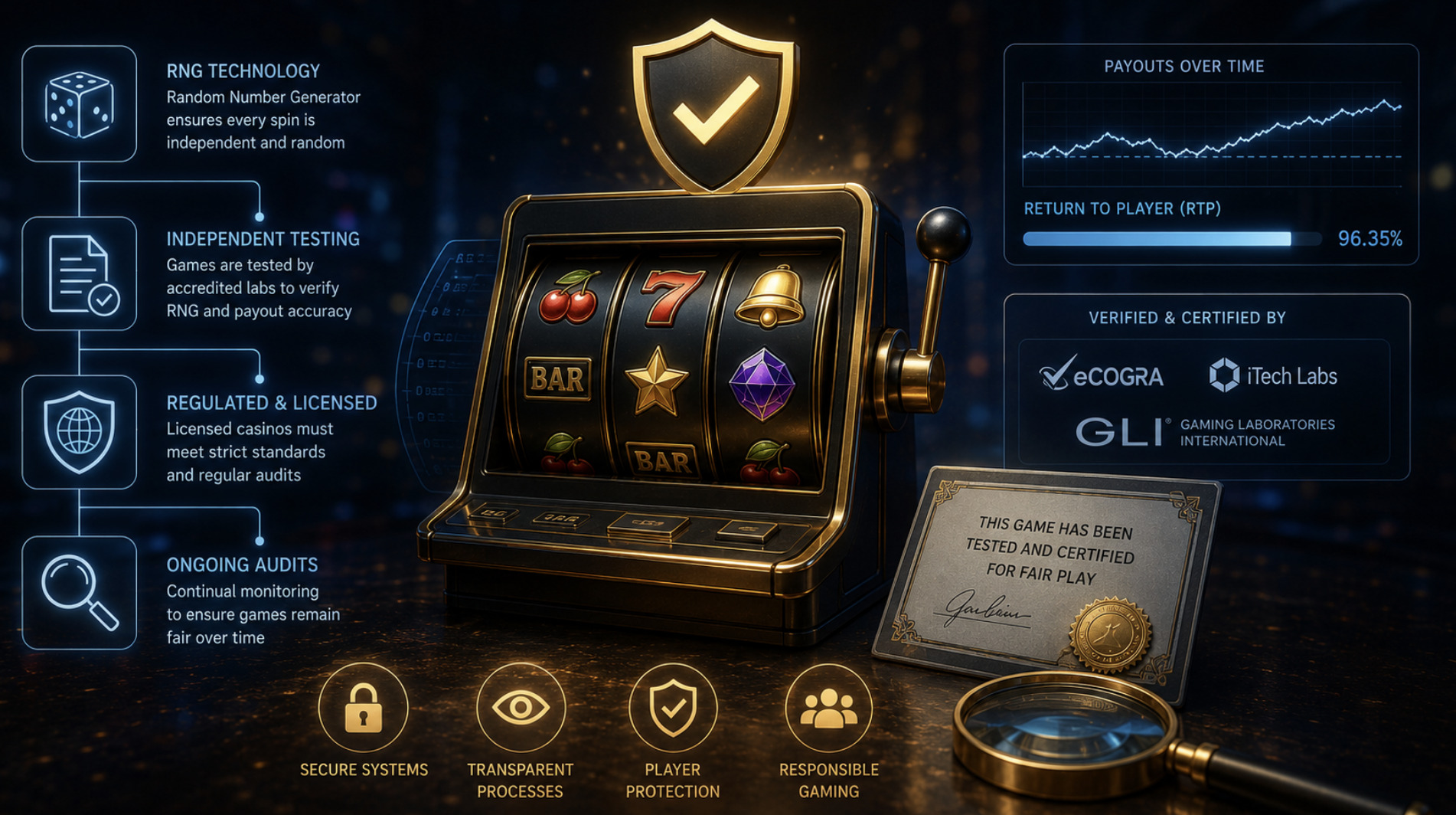
A reasonable question hangs over every online slot a player has ever spun: how do I know it is fair? Unlike a physical machine you can see and touch, a digital slot is software, its outcomes produced invisibly, and trusting it requires trusting something you cannot directly observe. The answer is not blind faith but a layered system of technology, independent testing, and regulation designed specifically to make online slots verifiably fair. Understanding that system — what guarantees fairness, who checks it, and how a player can recognise its presence — turns a matter of trust into a matter of evidence.
The random number generator at the core
At the heart of every online slot is a piece of software called a random number generator, and it is the foundation of the game's fairness. Its job is to produce outcomes that are genuinely random and unpredictable — to reintroduce, into a deterministic computer, the pure chance that a physical reel or a shuffled deck provides in the real world. Every spin's result is determined by a number the generator produces, translated into the symbols you see, with no memory of what came before and no way to be influenced by anything the player does.
This independence is the property that matters most, and it dispels a family of misconceptions in one stroke. Because each outcome is generated afresh and independently, a slot is never "due" to pay after a losing streak, and a recent win does not make the next spin less likely to land. The reels carry no memory; the generator does not know or care what the last hundred spins produced. A well-designed random number generator guarantees that outcomes are genuinely random and that neither the player nor the operator can predict or influence them — which is exactly what fairness in a game of chance requires.
Why the generator must be independently tested
A player might reasonably ask why they should trust that a slot's random number generator is genuinely random rather than quietly rigged, and the honest answer is that they should not simply take the operator's word for it. Fairness is precisely the kind of claim that cannot be credibly self-certified. This is why the system relies on independent testing: accredited laboratories that specialise in examining these generators, subjecting them to rigorous statistical analysis designed to detect any deviation from true randomness, and auditing the software to confirm it behaves as claimed.
These laboratories do the work a player cannot. They run the generator through vast batteries of tests, checking that its output is genuinely random and uniformly distributed, that the game returns what it claims to, and that nothing in the software undermines the fairness of the outcomes. Only generators and games that pass this scrutiny earn certification. This external verification is what converts a claim of fairness into a checked fact, and it is the reason regulated online slots can be trusted at all — not because the operator promises fairness, but because a disinterested third party has confirmed it.
Licensing and the framework of accountability
Around the technology and testing sits a third layer: regulation. A licensed operator has agreed to meet defined standards and submits to oversight, and in a regulated market those standards include requirements around the fairness of games, the use of certified random number generators, the protection of players, and mechanisms for resolving disputes. Licensing is, in essence, the accountability structure that binds the whole system together, ensuring that the technology and testing are not optional niceties but enforced obligations.
The practical value of licensing for a player is enormous, because it changes what happens when something goes wrong. With a licensed operator, there is a regulator standing behind the rules and a route to appeal; the games must meet defined fairness standards, and the operator faces real consequences for failing them. Licensing information is normally displayed by the operator and can be verified with the issuing authority, and checking it is one of the most important habits a player can adopt. A genuine licence from a recognised authority is a strong signal that a slot sits within a system of real oversight rather than operating unchecked.
Return figures and the difference between fair and favourable
An important distinction, and one the fairness systems make possible, is between a game being fair and a game being favourable. The two are not the same, and conflating them causes confusion. Fairness means the outcomes are genuinely random and the game returns what it claims — that it is honest. It does not mean the game is winnable in the long run, because every commercial slot carries a built-in mathematical margin for the operator, expressed in its return-to-player figure. A game can be perfectly fair and still, over time, tend to cost the player money, because that is what a house edge means.
This is why the fairness systems verify the return figure as well as the randomness: independent testing confirms that a slot actually returns the percentage it declares over the long run, so that the house edge is transparent rather than hidden. What this guarantees is honesty, not profit. Understanding this protects a player from two errors — believing that a fair game is one they can beat, and suspecting foul play when a fair game simply exercises its built-in edge. The relationship between return figures, fairness, and how a game plays is explored further in our guide to RTP and volatility.
How a player can recognise fairness
Because so much of the fairness system is invisible, a player benefits from knowing which signals indicate its presence. A slot backed by a certified random number generator, offered by an operator holding a genuine licence from a recognised authority, with evidence of independent testing available, is one operating within the verified system. Reputable operators make this information accessible rather than hiding it — the licence in the footer, the testing certifications, the game rules and return figures in the information panel.
The absence of these signals, or their obscurity, is itself informative and a reason for caution. A player cannot personally audit a slot's software, but they can read these signals, and doing so is the practical substitute for inspecting the invisible machinery directly. Checking that a game and operator sit within the licensed, tested, certified system transforms the act of trusting an online slot from blind faith into an informed judgement. It is a small habit that separates playing on platforms where fairness is verified from playing on those where it is merely asserted — a distinction well worth the moment it takes to check.
Conclusion
The fairness of an online slot is not something a player must take on trust; it rests on a layered system designed to make it verifiable. At its core, a random number generator produces genuinely random, independent outcomes, immune to the fallacies of "due" wins and hot streaks. Independent testing laboratories confirm that randomness and verify the return figure, converting a claim of fairness into a checked fact. Licensing binds it all into a framework of real accountability. And the distinction between fair and favourable clarifies that these systems guarantee honesty, not profit — the house edge remains, transparent and verified. A player who learns to recognise the signals of this system, and to check for them, replaces blind faith with evidence. Online slots are entertainment governed by chance and a built-in margin, best enjoyed within a budget and by adults aged 18 and over — and the fairness systems are what ensure that, within those limits, the game is at least an honest one.