
The European Heritage of Games of Chance — How Southern Europe Shaped a Tradition That the British Eventually Made Their Own
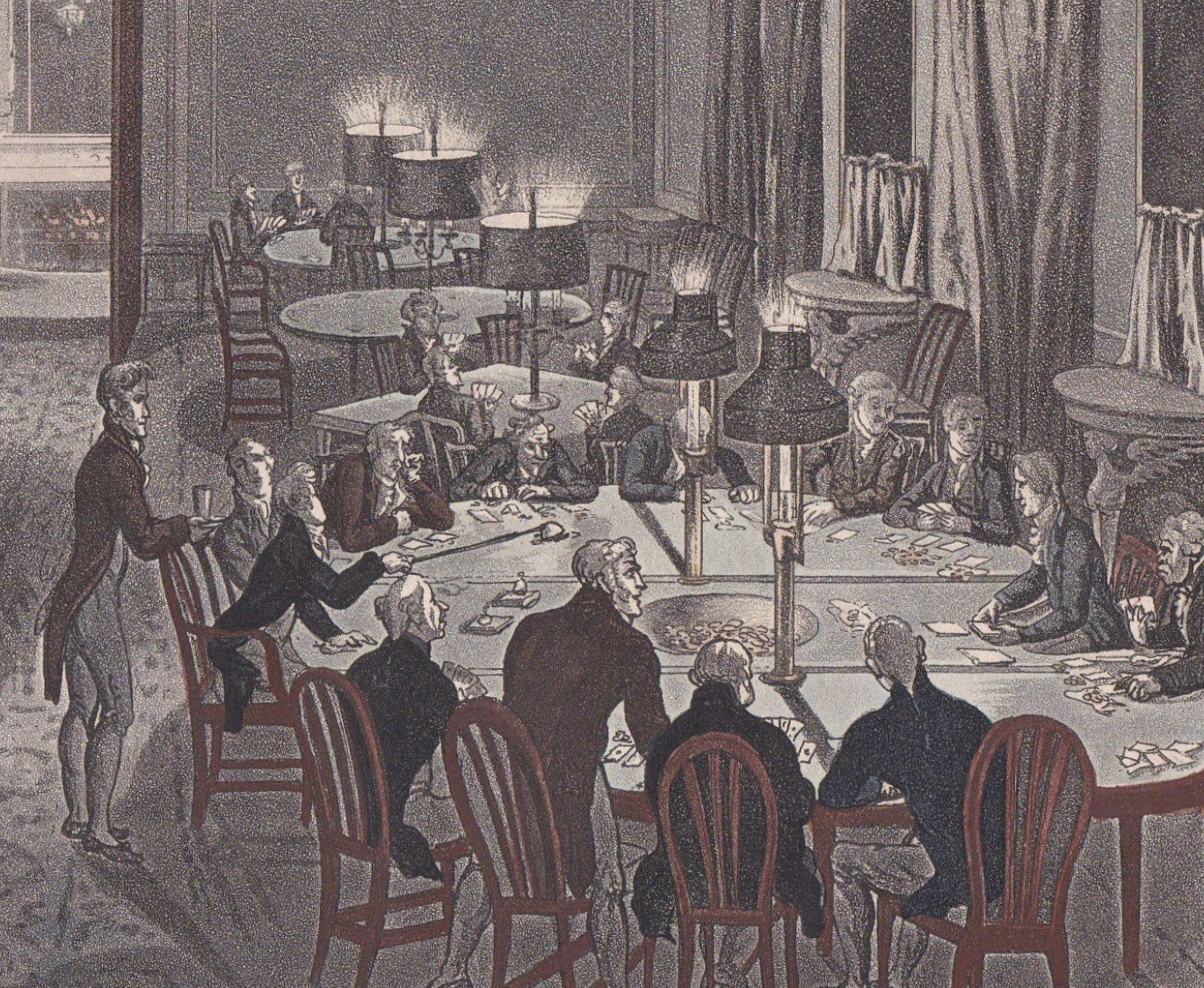
The historical reflex in this country, when the subject of games of chance comes up, is to think first of White's, of Brooks's, of the great Regency-era gaming clubs of St James's, of Crockford's appearing in the early 1820s to relieve the aristocracy of its inheritances under chandeliers in King Street. The reflex is not wrong. The clubs were a distinctive British contribution to the social history of the form. But they were a late development in a tradition that had been quietly built, over the better part of four centuries, on the other side of Europe — in the palaces of Venice, the spa rooms of the Italian republics, the royal lotteries of Spain, the merchant culture of the Portuguese ports. By the time a young gentleman in 1820s London was losing his patrimony at the hazard table, the structural grammar of the activity he was engaged in had already been written down, refined, and exported by southern European institutions that the British rarely credit.
This essay is a long view of that southern European heritage — what it actually produced, how the tradition arrived in Britain, and which parts of it survive in contemporary form. It is the kind of history one occasionally encounters in the more careful sort of country-house library and almost nowhere else.
Venice and the invention of the public room
The decisive moment is conventionally dated to 1638, when the Venetian Republic authorised the opening of a public gambling house on the ground floor of the Palazzo Dandolo near the church of San Moisè. It was called the Ridotto, and it operated continuously, under the supervision of the Council of Ten, for one hundred and thirty-six years before being closed in 1774. In its time it was the first government-sanctioned gaming establishment in modern European history.
The Ridotto's house rules established almost everything that would define the practice for the next three centuries. Entry required the baùta, the white Venetian mask worn with a black cloak, a tricorn hat, and an air of carefully maintained anonymity. The mask was the great social equaliser inside the room: it permitted a senator to lose his fortune to a courtesan and a foreign ambassador to walk away from the table without political consequence. Only the Venetian patriciate were allowed to operate the gaming banks, which kept the institution's profits flowing back to the families that ran the Republic. The principal games — basetta and, later, faraone — had simple rules and ruinous variance. The architectural setting was a sequence of rooms in a noble palazzo, candlelit and mirrored, with the largest and most public chamber giving on to progressively more private salons.
This was the model that the rest of Europe would, within a generation, set about copying.
Italy beyond Venice — Florence, Genoa, and the mathematics of risk
The Venetian model was not the only Italian contribution. Florence had operated a complicated regulatory regime through the fourteenth and fifteenth centuries in which certain games were prohibited and others were licensed under municipal taxation, a logic that was financial rather than moral: the Comune understood that gaming was a revenue source and that selective regulation produced more income and more control than blanket prohibition. The Florentine bische — the city's licensed gaming rooms — operated on a percentage paid to the Comune on stakes, and the practice survived even the moral storms of Bernardino da Siena's preaching in the early fifteenth century and Savonarola's bonfires of the vanities at the end of it.
Genoa contributed something more consequential than either. In 1576, Benedetto Gentile formalised what had been informal civic betting on the outcome of the Republic's senate-renewal lottery — five names drawn from a list of ninety — into a structured public game. The Genoese lotto, with its 5-from-90 mechanism, became the template for every modern numerical lottery. Anyone who plays the Italian lotto, the Spanish Lotería Nacional, or for that matter the British National Lottery, is interacting with a structure first formalised on the docks of sixteenth-century Genoa.
The third Italian contribution was mathematical. Luca Pacioli's Summa de arithmetica (Venice, 1494), best known for codifying double-entry bookkeeping, contained also the first quantitative formulation of the problem of points — how to divide stakes when a game is interrupted before completion. Pacioli did not solve the problem correctly; the full solution was given by Pascal and Fermat in their celebrated correspondence of 1654, and from there the modern theory of probability followed. The crucial point is that Gerolamo Cardano — physician, mathematician, astrologer, and committed player — had already, around 1564, written the first systematic treatise on the probability of games of dice and cards, his Liber de Ludo Aleae, published posthumously in 1663. Cardano wrote from the inside, his examples drawn from his own experience at the table. With Cardano, games of chance ceased to be a matter purely of fortune or divine will and became, for the first time in Europe, an object of mathematical analysis.
Spain and Portugal — the lottery as a public institution
The Iberian contribution was distinctive. Spain and Portugal, the great maritime powers of the sixteenth century, channelled the European gambling impulse principally through state-organised lotteries rather than through private gaming houses. The Spanish royal lottery, established by Carlos III in 1763 and known as the Lotería Nacional, became one of the most enduring public gaming institutions in Europe, surviving political revolutions, civil war, dictatorship and democratic transition essentially unchanged. The Christmas draw — El Gordo — remains, two and a half centuries later, the largest single lottery in the world by total prize money, woven into the texture of Spanish family life in a way that has no exact parallel in any other European tradition.
Portugal followed a similar pattern, with the Santa Casa da Misericórdia in Lisbon — a charitable confraternity dating to 1498 — taking responsibility for organising public lotteries from the mid-eighteenth century onward, with the proceeds funding hospitals, orphanages, and other social institutions. The model — state-licensed gaming as a revenue source for public welfare — would prove enormously influential across continental Europe and eventually arrive in Britain, by an indirect route, in the form of the National Lottery established in 1994.
The Iberian preference for lotteries over private gambling clubs had, over centuries, a particular cultural consequence. The Spanish and Portuguese inherited from their southern European tradition a public, communal, family-oriented relationship with games of chance that survives in the texture of contemporary life. The British inherited something quite different — the private club, the closed door, the cards in the back room. Both descended from the same Venetian original, but the genetic split happened early, and the two strands have looked different from the eighteenth century onward.
The Mediterranean trade and the diffusion of card culture
The eastern Mediterranean — and specifically the Greek islands and coastline — played a substantial but easily overlooked role in the diffusion of card culture across Europe. Playing cards reached Europe in the late fourteenth century along Mediterranean trade routes that connected Italian merchant cities with Mamluk Egypt and the broader Islamic world. Venetian and Genoese galleys carried not only spices, silk and silver but also the small printed objects that would, within a century, populate every European court. The Greek archipelago, much of it under Venetian rule for centuries — Crete until 1669, the Ionian islands until the Napoleonic period — was a natural stop in this commercial circulation. Greek merchants, sailors and innkeepers participated in the same Mediterranean gaming culture as their Italian counterparts, and the regional games that survive on the Greek islands today (the various forms of koltsina, vida, xeri) descend from the same Italian Renaissance card stock that produced the European tradition more broadly.
The Italian-style decks, with their four suits of coppe, denari, spade and bastoni, were the visual ancestors of every European playing card. The French simplification of the suits to hearts, diamonds, spades and clubs, which arrived in the late fifteenth century, was an economic adaptation — the French suits could be printed with stencils rather than hand-painted, dramatically reducing the cost of production — but the conceptual structure was Italian, and it remains Italian even on the most modern bridge deck in a Knightsbridge games room.
How the British took the inheritance
The British engagement with this southern European tradition is the subject of an entire literature, but the broad outline is straightforward. The Grand Tour, the eighteenth-century educational rite of passage for young British gentlemen, brought tens of thousands of them through Venice, Florence and Rome at exactly the period in which Italian gambling culture was at its most sophisticated. They returned with cards, with games, with stories, and with appetites that the existing British social infrastructure was not yet equipped to satisfy.
The result was the great age of the London gaming club, which emerged in the second half of the eighteenth century and reached its peak in the Regency. White's, Brooks's, Boodle's, Watier's, and eventually Crockford's became the British translation of the Italian casino into a form that suited the British aristocracy's preference for membership, exclusion, and the protection of a closed door. The faro tables of these clubs were directly Italian in their lineage, and the hazard played at them descended from the same Mediterranean dice traditions that the Romans had inherited and that the Italian republics had refined.
What the British added was the institutional architecture of the club itself — the membership committee, the blackball, the book of bets, the careful management of social access — and the legal framework that, beginning with the Gaming Act of 1845 and developing through to the Betting and Gaming Act of 1960, would eventually produce the regulated industry that survives in this country today. The physical setting has changed dramatically since then, but many of the underlying principles remain recognisable. Modern regulated platforms, whether traditional operators or contemporary brands such as DicePalace Casino, still depend on the same combination of controlled access, formal rules, trust between participants, and institutional structures that first distinguished the great gaming establishments of eighteenth- and nineteenth-century Europe from the informal gambling cultures that preceded them.
What survives
The inheritance is not equally distributed across the contemporary British landscape, but it is more present than most people realise. The National Lottery, established in 1994, is a direct descendant of the Genoese model of 1576. The licensed casino industry, regulated since 1968 and substantially restructured by the Gambling Act of 2005, traces its architectural conventions back, through Monte-Carlo and Baden-Baden, to the Venetian Ridotto. The cards in any deck sold at any British newsagent descend in suit structure from the Italian Renaissance and in graphic form from the French printing innovations of the fifteenth century. The very vocabulary of British gaming — the casino, the croupier, the banker, the baccarat, the faro — is largely loaned from Italian and French, with a few terms (hazard among them) of medieval Arabic origin that arrived in Britain through Iberian intermediaries.
The European heritage of games of chance is, in this country as in every other, a long inheritance with multiple stages and multiple authors. The British made it their own in the eighteenth and nineteenth centuries by adapting it to the institutional preferences of a particular ruling class. But the deeper structure — the room, the table, the masks, the calculation of odds, the lottery as public revenue — was built elsewhere, principally in southern Europe, principally between 1638 and 1815, and is still recognisable today on any street where the descendants of those institutions continue to operate.