
How Online Slot Fairness Is Actually Tested and Certified

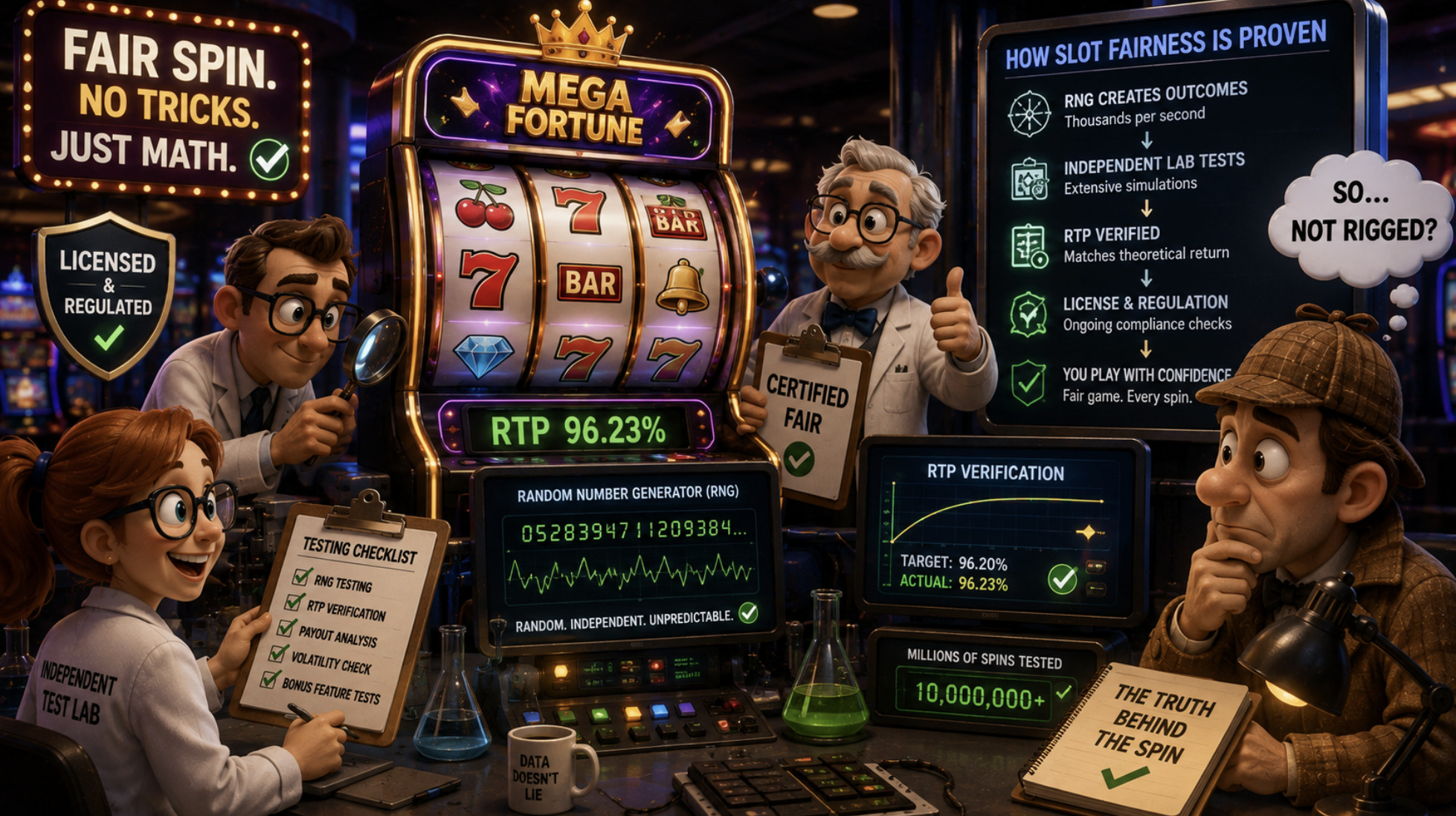
"Are online slots rigged?" is one of the most-asked questions in gambling, and it is a reasonable one. You cannot see inside the machine. There is no physical reel, no visible mechanism, just a screen and an outcome that seems to appear from nowhere. So it is fair to wonder whether the result is genuinely random or quietly tilted against you. The reassuring, and accurate, answer is that legitimate online slots at licensed operators are subject to a serious, multi-layered testing regime designed to ensure their outcomes really are random and their advertised return is genuine. Understanding how that regime works — the random number generator, the independent labs, the RTP verification, and the licensing that ties it together — is the best defence a player has against both baseless fear and genuinely dodgy sites. Here is how slot fairness is actually proven.
The random number generator at the heart of it
Every legitimate online slot is built around a piece of software called a random number generator, or RNG, and understanding it dissolves most of the mystery. The RNG's single job is to produce outcomes that are genuinely random and independent of one another. Every spin's result is determined by the RNG at the moment you press the button, with no memory of previous spins and no influence on future ones. There is no lever the operator pulls to make you lose after a win, and no hidden counter deciding you are "due" a payout; each spin is a fresh, independent draw.
That estimate of probability really is in there — a good price starts from a genuine assessment of how likely each outcome is — but it is wrapped inside a product designed to make money. This is why odds and probability are related but not identical: the odds encode a probability, and you can extract it, but they also carry something extra that pure probability would not. Learning to read the probability out of the price, and to notice that extra, is what separates someone who understands a market from someone who just reads the number.
Turning odds into probability
The mechanical part is genuinely simple, and it is the foundation of everything else. For decimal odds — the format that shows the total return per unit staked — you convert to implied probability by dividing one by the odds. A price of 2.00 implies a probability of one divided by two, or 50%. A price of 4.00 implies one divided by four, or 25%. A price of 1.25 implies one divided by 1.25, or 80%. That single operation lets you glance at any decimal price and immediately know what chance the market is assigning to that outcome.
This is called the implied probability, and it is the market's own estimate expressed as a percentage. Getting fluent at this conversion is transformative, because it lets you translate the entire language of odds into something intuitive. Instead of a vague sense that a price is "short" or "long," you can think in concrete terms: this outcome is being treated as roughly a one-in-four chance, that one as an eighty-percent favourite. Once odds become probabilities in your head, you can actually reason about whether a price looks generous or mean rather than just accepting it. This kind of clear reading is worth having before you open any sportsbook, whether a long-established name or an online platform like Dudespin, because it turns a bewildering wall of numbers into a set of probabilities you can compare and question.
The margin hiding in plain sight
Here is where the "price, not prophecy" idea becomes concrete and a little sobering. If you take every possible outcome in a market, convert each to its implied probability, and add them all up, the total comes to more than 100%. In a market that logically should sum to exactly 100%, you will find the implied probabilities add up to 105%, 107%, or more. That surplus above 100% is not a mistake. It is the bookmaker's built-in margin, often called the overround or the vig, and it is present in every market you will ever bet into.
This is the "extra" that pure probability would not contain, and seeing it changes how you read every price. Consider an even contest where both sides are offered not at the fair price of 2.00 but at 1.90. Each 1.90 implies about 53%, and 53% plus 53% is 106% — the extra 6% is the margin. It is why the odds on both sides of a coin-flip event are always a little shorter than a true coin-flip would justify, and it is how the business profits over time regardless of results. A bettor who does not know the margin exists is reading the odds as if they were a fair reflection of probability; they never are. Learning to notice it — to mentally strip the padding out of a line — is the second half of reading odds properly.
Why lines move, and what it tells you
The final piece is that odds are not fixed once published; they move, and understanding why sharpens your reading further. Two forces shift a line. The first is new information: a key player is ruled out, conditions change, and the estimated probabilities genuinely shift, so the price moves to match. This is the intuitive kind of movement, and when it happens the odds really are tracking a changed reality. The second force is less obvious and often missed — the flow of money. If a great deal of money backs one side, a bookmaker may shorten that side and lengthen the other, not because the true probability changed but to balance its exposure and protect its margin as bets come in.
This means a moving line is not always a signal about the real world. Sometimes it reflects fresh information; sometimes it merely reflects how people are betting. The useful habit is to ask, when a price moves, which force is driving it — genuine news or the weight of money — because only one of them is telling you something about the actual likelihood of the outcome. Holding that distinction in mind is what separates a naive read of a shifting market from an informed one, and it completes the picture of what odds really are: an estimate of probability, expressed as a price, inflated by a margin, and continually adjusted for information and money.
Reading odds like someone who understands them
Put the four ideas together and you can read any betting market with genuine clarity. Odds are a price, not a prediction. That price converts to an implied probability by a simple division. The implied probabilities across a market sum to more than 100%, and the surplus is the bookmaker's margin. And the price moves for two different reasons, only one of which reflects the real world. A person who holds all of that in mind looks at a line completely differently from one who treats the number as a mystical verdict — they can extract the probability, discount the margin, and interpret movement correctly.
It is worth ending with the honest caveat that no explanation of odds should omit. Understanding all of this does not let you beat the market. The margin is always present, outcomes remain genuinely uncertain, and betting is a form of entertainment that costs money on average rather than making it. The value of reading odds well is not a system — there isn't one — but clarity: knowing exactly what the market is telling you, and making any decision to bet a fully informed one, within limits set in advance. Treat betting as entertainment rather than a way to earn, and if it ever stops being fun, stepping back and seeking support is always the stronger move.
Frequently asked questions
How do you convert betting odds into probability? For decimal odds, divide one by the odds. A price of 2.00 implies a 50% chance (1 ÷ 2), 4.00 implies 25% (1 ÷ 4), and 1.25 implies 80% (1 ÷ 1.25). The result, called the implied probability, is the chance the market is assigning to that outcome.
Why do the implied probabilities add up to more than 100%? Because of the bookmaker's built-in margin, often called the overround or vig. Adding up the implied probability of every outcome gives a total above 100%, and that surplus is how the business profits over time. It means published odds are always slightly shorter than a fair price would be.
Are betting odds a prediction of what will happen? Not exactly. Odds are a price set by a bookmaker to take bets on all sides and profit over time. They start from an estimate of probability but are shaped by the business of taking bets and carry a margin, so they reflect probability and commerce rather than a neutral forecast.
Does understanding odds and probability let me win at betting? No. Reading odds well gives you clarity about what the market is saying, but it does not overcome the built-in margin or the genuine uncertainty of outcomes. Betting is entertainment that costs money on average, not a way to make money, and no understanding of odds changes that.